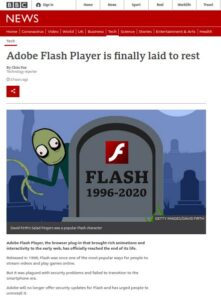
10 years after it became irrelevant (one of the first blogposts I wrote that generated discussions & traffic), Flash is now officially buried;
flash
Zap Flash before it zaps you
Lots of 0-day exploits on Flash, supposedly due to a hacking-for-money company having been hacked. Remove/ disable Flash if you value your security!
WP YouTube Lyte 0.8.0 released
Just a quick note confirming the release of WP YouTube Lyte 0.8.0. As previously described, the main new feature is support for embedding YouTube playlists in a high-performance and accessible kind of way that is typical of this plugin.
While testing the new feature on different platforms I noticed the playlist-player only comes in Flash, so it does not work on iPads or iPhones. Or “does not work on them yet”, as YouTube’s Jeff Posnick confirmed that support for HTML5 video in the embedded playlist player is on their todo-list.
The plugin is multi-lingual, with the following languages supported:
- English
- Dutch
- German
- Slovenian
- French (only the strings visible for visitors, not those in wp-admin)
- Spanish (only those strings visible for visitors for now)
Corrections, extra translations, bug reports and feature requests are all welcome feedback, either in the comments here or via the contact page.
I hope you enjoy the new version!
Did Flash really become irrelevant in 2010?
 Little over a year ago I must have been smoking some weird shit when writing that Flash would become irrelevant in 2010. Because after all, this is 2011 and there’s still plenty of Flash for Adobe aficionados to make a living and the famous html5 video codec issue hasn’t been fully sorted out yet either. So I was wrong, was I? Well, … not really!
Apple still stubbornly refuses Flash on the iPhone and more importantly the iPad, Microsoft’s Internet Explorer 9 joined the HTML5-crowd in full force and even Adobe is going HTML5 with support in Dreamweaver and in Illustrator and with a preview of Edge, “a tool for creating animation and transitions using the capabilities of HTML5”.
But is was only in December 2010 that I knew I was dead on with my prediction, when I overheard this conversation at work between a business colleague and a web development partner:
Business Colleague: I would like a personalized dashboard with some nice-looking charts in my web application.
Web Development Partner: No problem, we’ll do it in Flash!
Business Colleague: No, we want this to work on the iPad too!
The year technology-agnostic decision-making business people started telling suppliers not to use Flash, that was the year Flash became irrelevant and “the open web technology stack” (somewhat incorrectly marketed as HTML5) took over.
But how unstable is Flash really?
You probably read that Steve Jobs officially declared Flash a stability nightmare and that Adobe’s CEO responded that OS X is to blame. Hard to take sides in this blame-game, especially without access to Apple’s crash reports data. We do, however, have access to Mozilla’s crash-stats.mozilla.com. Could those figures provide us with at least some relevant statistics about Flash’s reliability?
I imported this csv-file with the top 300 crashers for Firefox 3.6.3 for the last 50 days (3.6.3 was released on April 1th) into a Google Docs spreadsheet and counted the number of crashes for each line where “Flash” or “NPSWF32” is in the signature (SUMIF without wildcard characters, seriously Google!?). You can find the spreadsheet here, but these are the results:
| total number crash reports for top 300 crashers: | 3583582 |
| crash reports with “NPSWF32” or “Flash” in signature: | 1154488 |
| flash-related crashes %: | 32.22% |
That’s right; almost 1/3 of the Firefox 3.6.3 “top crashers” are clearly related to Flash! So yes, there is good reason to consider plugins in general and Flash in particular a stability risk for Firefox. And for the record, the numbers for Mac seem to indicate that the problem is even (much) worse there! So hurray for Firefox 3.6.4 with Out of Process Plugins! And hey Adobe, get your Flash together!
Firefox Lorentz: Flash don’t crash here anymore
 A couple of days ago I installed Lorentz, a beta version of Firefox. Lorentz is virtually identical to Firefox 3.6.3, except that it incorporates part of the work of the Electrolysis team. Their “Out-of-process plugins”-code lets Firefox-plugins (on Windows & Linux, they’re still working on Mac OSX according to the release notes) run in a separate process from the browser, meaning Flash (but also Silverlight or Quicktime) can’t crash Firefox any more.
This feature actually is long overdue, a substantial amount of Firefox crashes are indeed caused by Flash failing and Mozilla’s competitors (MS IE, Apple Safari and Google Chrome) already have similar (or even more exhaustive) crash-protection.
Once you’ve installed Lorentz (or Chrome or IE8 or Safari off course) you can safely visit http://flashcrash.dempsky.org/, which exploits a bug that was reported 19 months ago and which may still cause the most recent Flash-version (10.0.45.2) to crash. And if flashcrash doesn’t bring up the plugin-crash-dialog, you can always kill the “mozilla-runtime” process that hosts the plugins, just for kicks!
Embedding YouTube HTML5-video with newTube
 With all the discussions about the place of Flash on the ever-evolving web and the excitement following Google’s announcement about YouTube going HTML5, one would almost forget that YouTube is only at the very start of their “open video” endeavor. The limitations of the current implementations are numerous; there’s no OGG (damn), no ads (yeah!) and no embedding either (damn) for example.
After looking into ways to call the YouTube mp4-file from within a Video for Everybody html-block (which is not possible, Google protects raw video-files using what seems to be a session-based hash that has to be provided in the URL), I decided to take another (dirty) approach; faking it!
The solution is entirely javascript-based and is as un-elegant as it is simple; create a html-file with a script include of http://futtta.be/newTube/newTube.js and a div with “id=newTube” containing a link to a YouTube-page and the script automagically takes care of the rest. Check out http://futtta.be/newTube/ to see it in action.
The result is an embedded YouTube player which will display the HTML5-version if you’re running a browser which supports mp4/h264 playback (i.e. a recent version of Chrome or Safari) and if you enrolled in the beta. If either of these preconditions aren’t met, you’ll just see the plain old Flash-player.
Don’t get your hopes up too high, newTube is probably not as obvious as normal YouTube embeds (for reasons I’ll get into in a follow-up post, when I have some time to spare that is). You’ll have to wait for someone (YouTube, Dailymotion, Vimeo, … are you listening?) to offer real embeddable html5-video (with support for both mp4/h264 and and ogg/theora).
But I did have fun creating the very first html5-capable embedded YouTube-player 😉
Flash isn’t evil, but …
 Last week’s prediction about Flash becoming irrelevant was pretty controversial, and some of you Flashheads had interesting remarks and -rhetorical- questions both in the comments and on Twitter (a big shout-out to Clo Willaerts for sharing). So without further ado, here’s my follow-up.
Flash isn’t evil
Some people seemed all too happy to dismiss my post as being plain old Flash-bashing. Sorry to disappoint you, but I”m not saying Flash is evil or that it will (or should) disappear altogether. Next correction: I do have Flash player installed and in general I do know if a application is made in Flash or not. Heck, the web has been my job for more than 10 years now and Flash has been a point of interest for quite some time already. And yes, there indeed are innovative web applications and games that are build in Flash. That being said, I do think (because of accessibility, SEO and some more philosophical reasons) it’s best to avoid using Flash to develop a site’s core functionality if the same can be achieved with non-propriety, standard web technology.
It’s not about Flash vs HTML5
The comments on last week’s blogpost seemed to focus very much on the individual merits (or lack thereof) of HTML5, CSS3 or Canvas, as if these are islands with no history and no connections to the web mainland. This is, off course, wrong; these “new” technologies just happen to be the most recent evolutions of the core components of the rapidly evolving ecosystem that is the “open web”. Moreover, with HTML, CSS and Javascript being the brick and mortar, libraries such as JQuery, Dojo and YUI are the “prefab” building blocks of open web development, offering plug&play components to efficiently build cross-browser rich web interfaces. So the discussion is not about Flash vs HTML5, but about the choice between Flash and the powerful “open web technology stack”.
about:evolution
“The only constant is change” and that’s all the more valid on the web. Flash has an important role to play in this respect, having pushed the boundaries of web-based UI’s for many years. But as some of the cutting-edge features that once were only available in Flash, can now be created more efficiently using non-propriety technology, there’s a shift towards the use of those open web components (e.g. the Flash carousel on National Geographic website that was shown in the Adobe video from my previous post has been replaced by a JQuery implementation).
I believe (and that’s what the previous post was about) this trend will continue in 2010 because of features of HTML5, CSS3, canvas, … becoming available to a wider audience either natively (in new browsers) or through libraries that provide cross-browser compatible implementations. And yes, I’m afraid that in my book that means Flash will become less relevant (“irrelevant” in my previous post being an obvious hyperbole).
Loose ends & examples
- The <video> codec problems Serge fears can -and should- be easily hidden from end-users (as Apple does for example). Moreover the patent-related codec-issue will, I predict, be solved in 2010 with Google acquiring On2 Technologies and putting at some (if not all) of the codecs (VP3 was the basis of Theora, VP6 is in Flash 8 Video and JavaFX) in the public domain
- <Canvas> is already in the wild and doing just fine, thanks for asking Stefan. Major webapps with great graphical UI’s such as 280slides, Mindmeister, Bespin, Google Maps and Yahoo Pipes depend on it. Cufon, JQuery visualize and Dojo GFX use it as well and yes, Canvas can be implemented cross-browser (even in IE6) thanks to the explorercanvas library (and with Microsoft actively participating in the discussions about the canvas-spec, one could expect MS to one day release a browser that has native canvas-support)
- Despite great efforts by Adobe, Flash on the mobile web (i.e. in a browser, non-browser implementations are irrelevant in the discussion about “open web vs flash”) remains almost non-existent. The fact that Apple continues to refuse Flash for the iPhone only makes this worse, due to the seemingly untouchable “game-changer” status of their phone and due to the fact that more than 60% of all mobile pageviews originate from their mobile devices.
To sum it all up: when Adobe Flash evangelist Serge writes “Flash Player has it’s place on the web today and in the future” I can only agree. But I’ll bet you that place in the future will be less prominent than the one it holds today.
2010: the year Flash became irrelevant
My 2nd prediction for 2010 (the first one being ‘offline is the new online‘): the glory days of Flash are over. The reason for this is twofold; the mobile web and the strong advances “open web” technology is making.
Open web moving in, fast
Remember the days when everybody wanted to spice up otherwise dull websites with “a flash splash page” and “flash menu’s”? Now menu’s are built in accessible, SEO-friendly HTML once again, using CSS to add style and even behavior, adding some Javascript if magic dust is required . And splash pages, well, those were pretty useless to begin with. Adobe Flash’s stronghold now is video playback and animation, but they’re bound to eventually lose that battle as well.
For starters; video (and audio) on the web doesn’t have to be based on a plugin any more. Firefox, Safari and Chrome have built-in html5 audio- and video-playback capabilities and several video-sites are already experimenting with those native browser multimedia-features. True, there’s still that darn codec-problem, but I bet you that’ll get solved in 2010 (clue; Google is negotiating the acquisition of video codec specialists On2 Technologies).
On the animation-front things are moving at such a fast pace, I even need a bulleted list;
- Safari has great CSS animations, transforms and transitions (and Mobile Safari has even such goodies), many of which are in the process of being added to the CSS3-specs, with support for CSS transitions and transforms being made available in development builds of Firefox 3.7 and Opera 10.5.
- HTML5’s canvas (cross-browser javascript-able 2D bitmap-based graphics) is gaining a lot of momentum. Check out the applications and games on http://www.canvasdemos.com/ to see just how much can be accomplished now, in today’s browsers (really, go check out those demo’s, some are mind-boggling)
- Both Firefox 3.7 (on Windows) and Internet Explorer 9 are expected to ship with Direct2D– and DirectWrite-based hardware-accelerated web page rendering (with a huge performance boost for e.g. SVG and web fonts, with canvas expected to benefit as well).
- Browser-makers are gearing up support for WebGL, a canvas-based open standard for cross-browser 3D graphics, with Firefox 3.7 expected to be the first browser to support the spec. Check out glge.org for a javascript library that takes advantage of WebGL. The site also features a demo of a Blender-created 3D world exported to WebGL.
Mobile; the Flash-less revolution
There’s no Flash on the iPhone. It wasn’t there at launch, back in 2007 and –despite me thinking it would arrive in 2009– it’s still not there. This decision is said to be Steve Jobs’, who in 2008 stated that a full-fledged version of Flash “performs too slow to be useful“. And it seems as though the turtlenecked CEO was right all along; on one hand the mobile web boomed thanks to the iPhone browser and on the other hand Adobe is still struggling to provide a decent mobile Flash experience, despite huge efforts in 2009. The fact is there’s no Flash on the booming mobile web, no-one seems to miss it much and it doesn’t look like that will change any time soon.
Adobe’s answer; mobile banners & deploy to Appstore
So with a Flash-less mobile web and with strong browser-native competition for both multimedia and graphics on the “normal” web, how does Adobe see it’s future? Well, they plan to roll out “iPhone packager for Flash” in CS5, allowing any Flash developer to publish to the AppStore, but there’s still no news about in-browser Flash on the iPhone.
For non-Apple devices, Adobe is boasting a preview version of Flash 10.1 in a mobile browser (the Android 2.0 browser on Google Nexus One in this case) with this promo video;

I don’t know about you, but somehow a sub-par game, web video and banners don’t convince that Flash has a bright future ahead. Not on mobile and maybe even not on the open web as it’s shaping up to be.
But maybe you think Flash will remain in the spotlights despite all of this? Why? Let us know in the comments!
Flashback: C64 Encounter op Youtube
Héél lang geleden speelde ik Encounter op m’n Commodore 64 (ik heb er op zolder nog eentje staan, for old times sake) en dat zag er zo uit:

Er is overigens een port van c64 emulator Frodo voor Android en de Encounter-d64 is ook downloadbaar, nu nog een joystick op m’n Hero vijzen en we kunnen weer spelen! Anders moet ik die flash-based c64-emulator eens proberen?